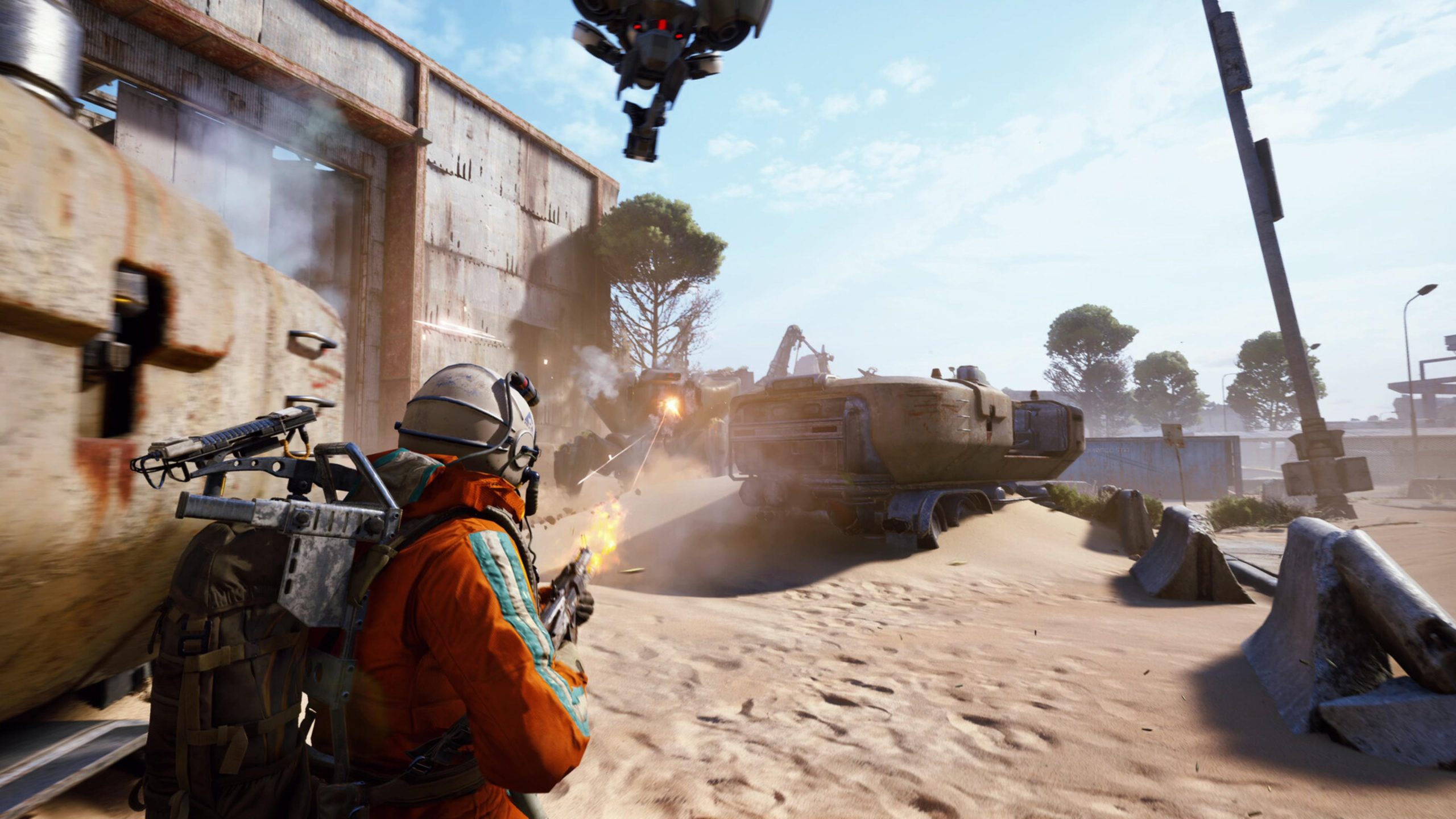
ARC Raiders is a game that quietly defies expectations. Developed by Embark Studios, a team formed by former DICE developers, and released in 2024 for PC and current-generation consoles, ARC Raiders does not attempt to overwhelm players with constant spectacle or excessive systems. Instead, it offers a focused, tension-driven experience built around cooperation, survival, and the ever-present risk of loss. While often categorized as an extraction shooter, ARC Raiders approaches the genre with restraint and a clear sense of identity, favoring atmosphere and decision-making over chaos. This review was written by Bros Games.
Basic Concept and World Setting
ARC Raiders is set in a near-future version of Earth that has been devastated by a mysterious mechanized threat known simply as ARC. These autonomous machines descend from orbit and patrol the surface, forcing humanity underground. Players take on the role of Raiders — individuals who venture out of subterranean settlements to scavenge resources, complete missions, and survive encounters with both ARC units and other Raiders.
The setting is post-apocalyptic, but not in the traditional sense of total ruin. The world is quiet, open, and often strangely beautiful. Abandoned cities, rolling hills, and industrial ruins dominate the landscape, creating a tone that feels melancholic rather than overtly bleak. This subdued atmosphere is one of the game’s defining characteristics and sets it apart from louder, more aggressive titles in the same genre.
Developer Vision and Design Philosophy
Embark Studios approached ARC Raiders with a clear design philosophy: tension should come from uncertainty, not constant action. Unlike many extraction-based games that emphasize relentless PvP encounters, ARC Raiders gives players room to breathe. Conflict is always possible, but rarely forced. This choice makes the game more approachable for players who enjoy cooperative gameplay but may be turned off by overly competitive environments.
The developers also prioritized fairness and clarity. Enemy behavior is readable, audio cues are reliable, and combat outcomes feel earned rather than arbitrary. This attention to detail reflects Embark’s experience with large-scale multiplayer design while avoiding many of its common frustrations.
Gameplay Loop and Core Mechanics
At its core, ARC Raiders revolves around expeditions. Players begin in an underground hub where they manage equipment, accept contracts, and prepare for deployment. Once on the surface, objectives may include scavenging specific materials, eliminating ARC units, or exploring points of interest.
Every decision carries weight. Equipment brought into an expedition can be lost permanently if the player dies, creating constant tension. This risk-reward dynamic is central to the game’s identity and encourages cautious, thoughtful play rather than reckless aggression.
Combat is methodical. Weapons have noticeable recoil, limited ammunition, and distinct roles. There is no “spray and pray” mentality here; positioning and timing matter. Enemies, particularly ARC machines, are dangerous and often better avoided than confronted head-on. Some encounters demand teamwork, while others reward patience and stealth.
Movement is grounded and deliberate. Sprinting recklessly can attract unwanted attention, and noise plays a significant role in enemy detection. These mechanics work together to create a sense of vulnerability that persists throughout each expedition.
Cooperative and Multiplayer Elements
ARC Raiders is primarily designed as a cooperative experience, though solo play is entirely viable. Teams can coordinate loadouts, share resources, and revive one another during combat. Communication becomes especially important when navigating dangerous areas or deciding whether to engage enemies or retreat.
Player-versus-player interactions exist but are not the focal point. Encounters with other Raiders are unpredictable, ranging from hostile shootouts to tense standoffs where both parties choose avoidance. This ambiguity adds to the game’s tension without dominating the experience.
The absence of forced PvP objectives makes ARC Raiders feel less punishing than many extraction shooters. Players who prefer cooperation over competition will likely find this approach refreshing.
Progression and Customization
Progression in ARC Raiders is steady and measured. Instead of traditional leveling systems that increase player power dramatically, progression focuses on unlocking new gear, crafting options, and cosmetic customization. This design helps maintain balance and prevents experienced players from completely overpowering newcomers.
Crafting plays an important role, allowing players to convert scavenged materials into useful equipment. Choices matter here as well, since resources are limited and crafting decisions can impact future expeditions.
Customization is primarily functional rather than purely cosmetic. Loadouts can be tailored to specific mission types, encouraging experimentation and adaptability.
Graphics and Visual Design
Visually, ARC Raiders adopts a clean, modern aesthetic that emphasizes readability and atmosphere. The environments are detailed without being cluttered, allowing players to easily identify threats and points of interest. Lighting is naturalistic, often using overcast skies and soft shadows to reinforce the game’s subdued tone.
ARC machines are particularly well-designed. Each enemy type is visually distinct, making it possible to identify threats at a glance. Their mechanical movements and sound design contribute significantly to the game’s sense of danger.
Performance across platforms is stable. On PC, ARC Raiders runs well on mid-range systems, with scalable settings that allow players to prioritize performance or visual fidelity. Console versions maintain consistent frame rates with minimal technical issues.
Audio and Sound Design
Sound design is one of ARC Raiders’ strongest assets. Environmental audio plays a crucial role in gameplay, providing cues about nearby enemies, incoming threats, and other players. The distant hum of ARC machinery or the echo of gunfire can dramatically alter a player’s decision-making in real time.
The soundtrack is understated but effective, reinforcing tension without becoming intrusive. Music often fades into the background, allowing ambient sounds to take center stage.
Voice work is minimal but appropriate, keeping the focus on gameplay rather than exposition.
Game Modes and Longevity
ARC Raiders does not rely on a large number of distinct game modes. Instead, it focuses on refining its core loop. While this approach results in a cohesive experience, it also raises questions about long-term variety.
Over extended play sessions, missions can begin to feel familiar, especially for players seeking constant novelty. Embark Studios has indicated plans for ongoing updates and content expansions, which will be crucial in maintaining long-term engagement.
That said, the moment-to-moment tension of expeditions remains compelling, particularly when playing with friends.
System Requirements (PC)
Minimum requirements include a modern quad-core CPU, 16 GB of RAM, and a mid-range GPU. Recommended settings benefit from a stronger graphics card but do not demand top-tier hardware. An SSD is recommended for faster load times and smoother streaming.
The game is well-optimized and does not suffer from the severe performance issues that often plague multiplayer titles at launch.
Strengths and Weaknesses
ARC Raiders’ greatest strength lies in its restraint. It does not attempt to be everything at once, instead delivering a focused, atmospheric experience that rewards patience and teamwork. Its approachable take on the extraction shooter formula makes it accessible without sacrificing tension.
The primary weakness is its limited variety over long play sessions. Without frequent content updates, some players may find the experience repetitive. Additionally, players seeking constant PvP action may feel underwhelmed.
Verdict
ARC Raiders is a thoughtful, well-crafted game that proves less can be more. By prioritizing atmosphere, cooperation, and meaningful decision-making, it offers a refreshing alternative to louder, more aggressive multiplayer shooters. While its long-term longevity will depend on continued developer support, its foundation is strong and its identity clear.