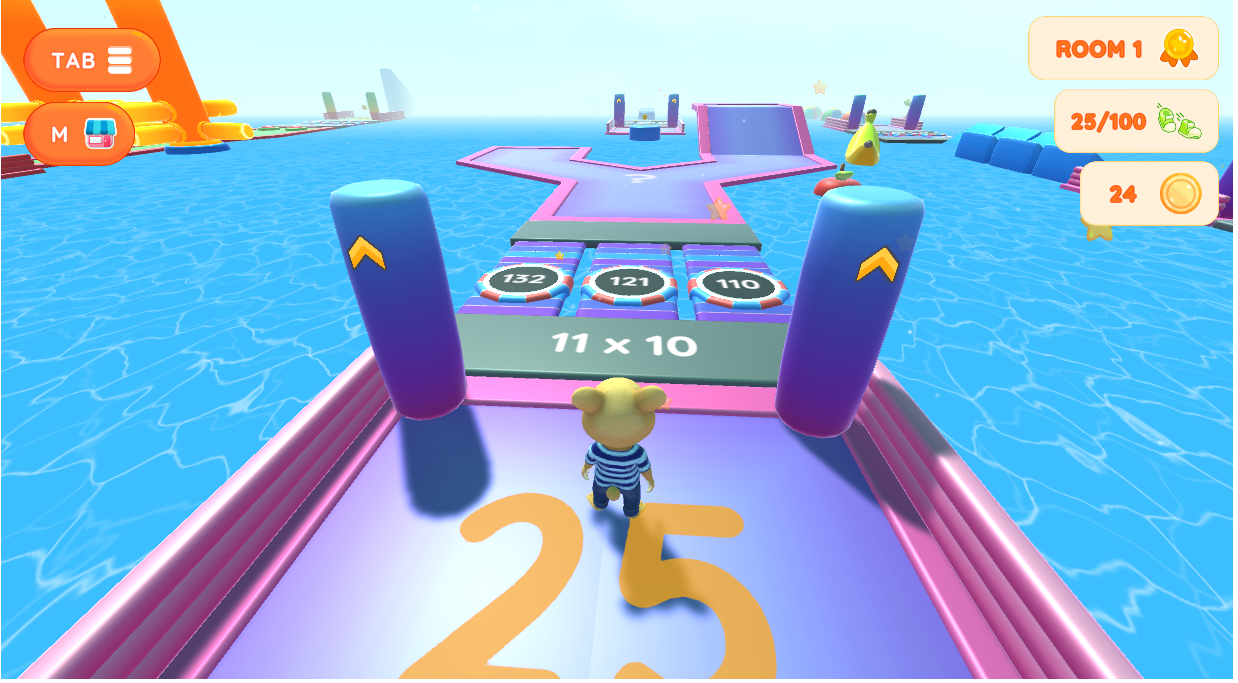
3×3 Obby is a browser obstacle-course game built around a very simple idea: guide your character through a course filled with platforms and jumps, avoid falling, and reach the finish. You move through the level, line up your character for each obstacle, jump across gaps, and try to maintain control from one section to the next. There isn’t much to explain before you start, which is exactly what makes the game easy to pick up. The real challenge begins once you realize that knowing how to jump and actually landing every jump are two completely different things. Source : https://obby3x3.com
I tend to approach games like this in a slightly unhealthy way. I don’t just want to finish a course. Once I’ve learned the layout, I want to complete it cleanly. I want to stop making the same stupid mistake. I want to look at a difficult section that gave me trouble earlier and eventually pass it without even hesitating.
That’s where 3×3 Obby got me.
The first attempt was mostly about understanding the course. I wasn’t particularly interested in speed because I didn’t know what was coming next. I wanted to see where the awkward jumps were, which platforms gave me enough room to reposition, and where the game started demanding more precise movement.
The second attempt was different.
Now I knew what was coming, so mistakes became much more annoying.
I knew I had enough room for a jump, yet somehow I still missed it. I knew a platform was coming up, but I approached it from the wrong angle. Those failures weren’t caused by not knowing the level anymore. They were caused by me not executing properly.
And honestly, that’s when an obby becomes interesting.
A beginner usually plays by reacting. You see a platform, then decide what to do. You jump, land, and look for the next obstacle. That’s perfectly fine when you’re learning, but experienced players eventually start planning their movement before they reach the obstacle.
You can see the difference immediately.
Instead of asking, “Can I make this jump?” you’re thinking, “Where do I need to stand before I make this jump?”
That sounds like a tiny change, but it completely alters how you approach the course.
Positioning is probably the most important skill I’d recommend learning in 3×3 Obby. If you’re standing in the wrong place, even a perfectly timed jump can fail. Before moving toward a gap, take a moment to line yourself up. You don’t need to be painfully slow, but you do need to be deliberate.
I’ve lost plenty of attempts because I was too impatient to spend one second getting into the correct position.
That one second would have saved me several minutes.
This is also why I wouldn’t recommend beginners trying to speedrun the course immediately. First, learn how the character moves. Understand how much distance you can cover, how your jumps feel, and how much correction you can make while moving. Once those things become natural, speed starts becoming useful.
Before that, speed is mostly another way to fall faster.
The course design creates a nice rhythm when you start getting comfortable. Some sections feel straightforward, allowing you to move confidently, while others force you to slow down and pay attention. That contrast keeps the experience from becoming one long sequence of identical jumps.
For me, the best sections are the ones where I initially think, “That’s easy,” and then immediately discover that my timing is slightly off.
Those are the jumps that make you improve.
I also like the fact that failure is so easy to understand. When you fall, you generally know what happened. Maybe you jumped too early. Maybe you moved too far to one side. Maybe you didn’t line yourself up correctly. Unlike some games where losing can feel random, an obstacle course gives you a very direct lesson.
You made a mistake.
Try again.
That simplicity can be surprisingly motivating.
New players should also understand that repetition is not necessarily a bad thing. If you fail the same obstacle several times, don’t immediately assume you’re stuck. Watch your own movement. Ask yourself what changes between successful and unsuccessful attempts. Are you approaching from a different position? Are you jumping at a different point?
Small differences matter.
Once you identify them, the obstacle usually becomes much easier.
Experienced players can take this further by trying to make their movement consistent. It’s one thing to clear a difficult jump once. It’s another to clear it ten times in a row. Consistency is where you really start to understand whether you’ve mastered a section or simply got lucky.
That’s the part I enjoy most.
I’ll sometimes deliberately replay a section I’ve already completed just to see whether I can make it cleaner. Maybe I can reduce unnecessary movement. Maybe I can approach the next platform without stopping. Maybe I can create a smoother route through the section instead of treating every jump as a separate event.
It becomes almost like solving a small puzzle with movement.
You aren’t just asking whether you can finish.
You’re asking whether you can finish well.
The game also works nicely as a short-session experience. You don’t necessarily need an entire evening to enjoy it. You can play for a few minutes, work on a difficult section, and leave. Then you can come back later and immediately remember what you were trying to improve.
That’s useful for browser games because not everyone wants to commit to a huge session.
At the same time, 3×3 Obby can become surprisingly absorbing if you have the competitive mindset I apparently brought into it. Once you start thinking about completing the course without mistakes, a simple level can suddenly feel like a personal challenge.
Of course, the game could benefit from more variety over time. Additional courses, harder stages, unusual obstacles, or different challenges would give experienced players more reasons to keep returning after they’ve mastered the existing content. Obby games depend heavily on level design, so fresh layouts are always valuable.
Still, the basic formula works.
For beginners, my advice is to forget about speed and focus on control. Look ahead, line up your jumps, and don’t panic when you make a mistake. If a particular obstacle keeps beating you, stop rushing it and study your approach.
For experienced players, I’d suggest doing the opposite of what your instincts might tell you. Don’t just try to move faster. Try to move better. Once you know the course, eliminate unnecessary pauses and movements. Find a reliable approach for every difficult section and see how consistently you can reproduce it.
That is where 3×3 Obby becomes more than a casual jumping game.
It becomes a test of precision.
And precision is a funny thing. You don’t notice how much you depend on it until you’re one tiny movement away from landing safely and suddenly watching your character fall into the void.
I’ve had enough of those moments to know that the game can be frustrating.
But it’s the good kind of frustrating.
The kind where you immediately think, “Okay, I know what I did wrong. One more try.”
And then you try again.
That’s probably the simplest way I’d describe 3×3 Obby. It isn’t complicated, it doesn’t need an enormous collection of mechanics, and it doesn’t try to overwhelm you with unnecessary features. Instead, it takes a basic idea and asks a surprisingly difficult question:
How accurately can you control your character?
For me, that’s enough to keep playing.