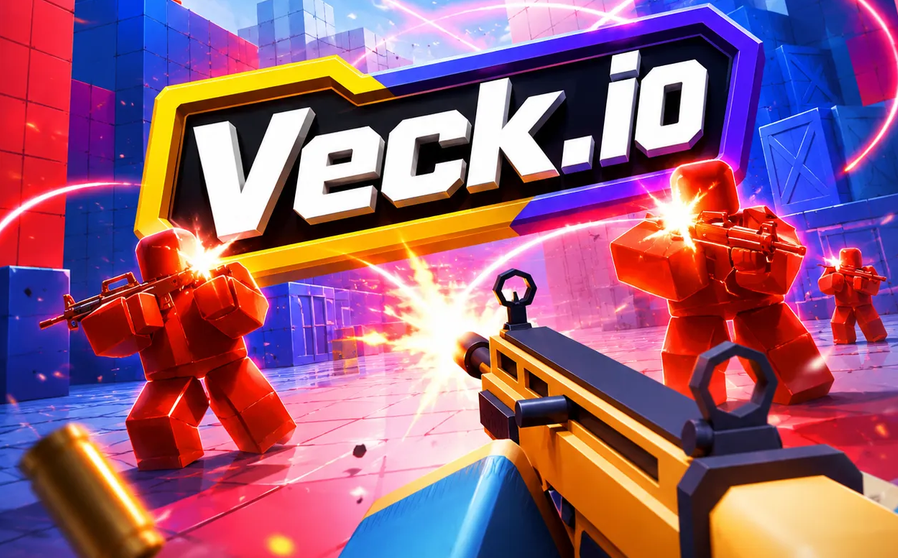
I’ve always thought browser shooters are at their best when they give you enough freedom to make mistakes. If everything is automated and the game practically tells you what to do, there’s not much satisfaction in getting better. Veck io caught my attention because it looks simple at first, but once you spend enough time with it, you start noticing that winning isn’t just about having quick reactions.
You need to think.
That became obvious to me after a few bad matches.
When I first started playing, I treated Veck like a typical arena shooter. Find an enemy, aim, shoot, move on. It worked occasionally, but I was also getting eliminated far more often than I expected. Eventually I realized I was concentrating almost entirely on the shooting part and ignoring everything that happened before the shooting started.
That was my mistake.
 Veck io is much more enjoyable when you treat positioning, movement, weapon selection, and timing as parts of the same system. The game offers a large collection of weapons and several multiplayer modes, including free-for-all, team-based battles, 1v1 encounters, and Gun Game-style matches.
Let’s start with weapons because this is probably the easiest place for a new player to make the wrong assumption.
More weapons don’t automatically mean you should try all of them immediately.
When I was learning the game, I found it much more useful to settle on a dependable weapon first. An assault rifle or another versatile firearm gives you room to learn movement and map positioning without constantly worrying about whether your equipment is appropriate for the situation. Once those basics become comfortable, experimenting with shotguns, snipers, launchers, melee weapons, and other options becomes much more interesting.
A shotgun, for example, isn’t simply a weapon with a shorter effective range. It changes how you should play. You’re looking for close encounters, corners, and situations where you can force an opponent into a disadvantage. A sniper creates almost the opposite problem. You need patience, distance, and a good understanding of where opponents are likely to appear.
That sounds obvious when written down.
In an actual match, people forget it constantly.
I’ve watched myself do it. I’ll equip a weapon that works beautifully at medium range and then start taking fights from awkward distances, wondering why the results aren’t great. The weapon isn’t necessarily bad. I’m using it badly.
That’s an important distinction.
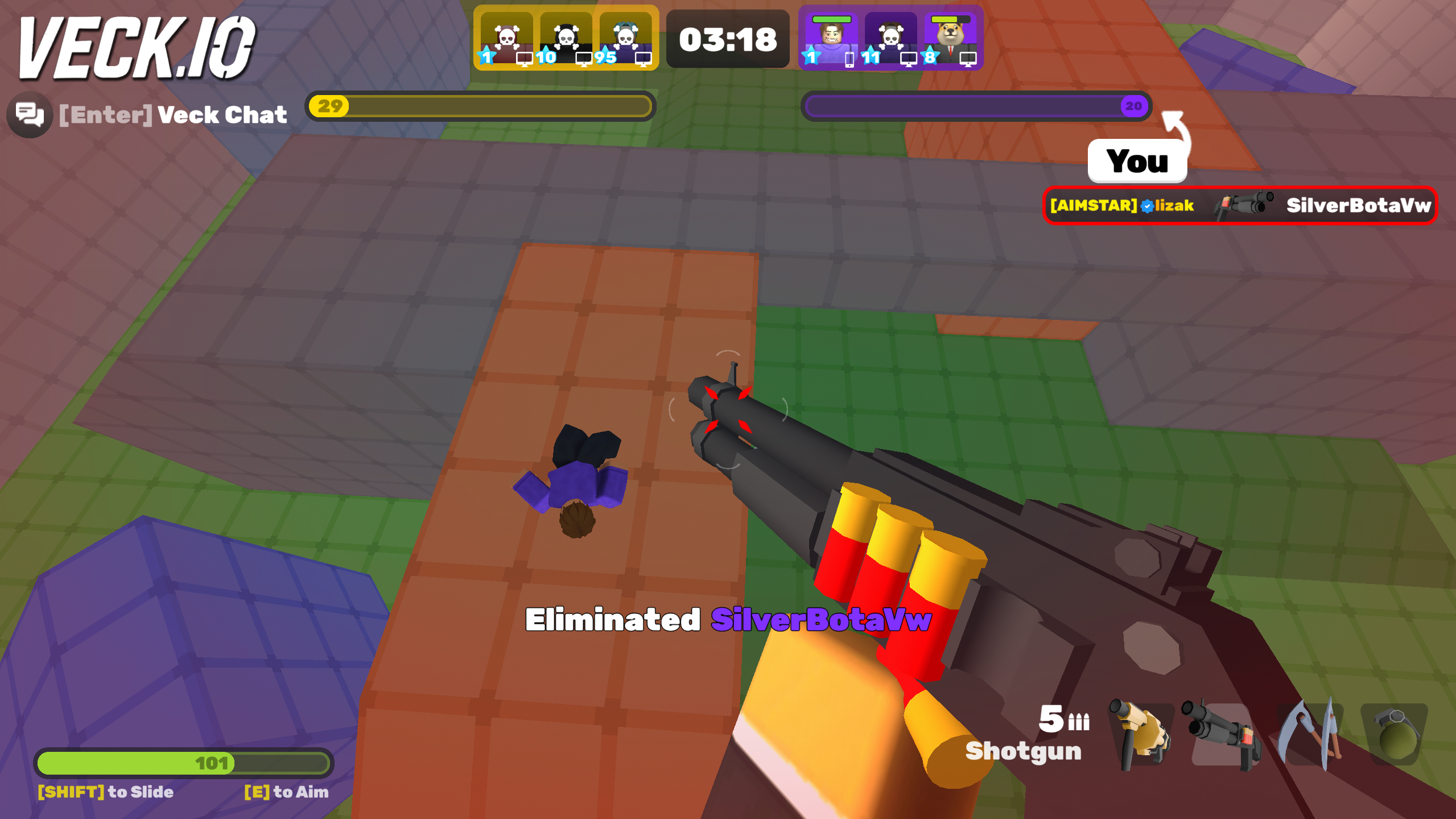
But there’s another mistake here.
Moving constantly doesn’t automatically make you difficult to kill.
Good movement has a purpose. You want to make yourself harder to hit while maintaining control of your own aim. If you’re jumping randomly every two seconds, you’re not necessarily playing better – you’re just making your own movement predictable in a different way.
I’ve found that controlled movement is much more useful. Strafe when you need to create a difficult target. Slide when you need to change position quickly. Jump when it actually helps you avoid an attack or reach a useful position.
Basically, don’t turn movement into decoration.
Use it to win fights.
The 1v1 mode is particularly useful for learning this because there’s nowhere to hide behind teammates. If you lose, you have to examine what actually happened. Did you miss your shots? Did you choose the wrong weapon? Did you expose yourself too early? Did you chase your opponent instead of forcing them into a bad position?
That’s why I think 1v1 is valuable even if it isn’t your favorite mode.
It exposes weaknesses.
Team modes create a different challenge. When you’re playing alongside other people, individual mechanical skill is only part of the equation. You need to understand when to push, when to hold an area, and when to support a teammate instead of running after an enemy who has already disappeared around a corner.
This is where impatient players tend to struggle.
I’ve certainly been guilty of it.
You eliminate one opponent and immediately think, “I can get another.” So you push forward, round the corner, and suddenly you’re facing two enemies while your teammates are nowhere nearby.
Congratulations. You’ve just turned a good situation into a bad one.
Sometimes the smarter play is to stop.
Reload.
Recover.
Look at the map.
Then move.
It sounds less exciting, but winning isn’t always about making the most aggressive play. Often it’s about recognizing when aggression is no longer worth the risk.
That becomes even more important in longer sessions because Veck io’s relatively quick matches make it tempting to play on autopilot. You finish one round, immediately jump into another, and eventually your decision-making gets sloppy.
I’ve noticed that when I stop thinking about positioning, I start making the same mistakes repeatedly.
So I try to reset after every match. Not literally, of course. I just ask myself one simple question: what actually caused my deaths that round?
If the answer is “bad aim,” I work on aim.
If the answer is “I kept pushing alone,” then I stop doing that.
If I don’t know why I died, I probably wasn’t paying enough attention.
That’s a surprisingly useful habit.
The maps also become more important as you gain experience. New players tend to see the environment as something they simply run through. Experienced players start seeing routes, cover, angles, escape options, and likely engagement points.
You begin remembering where fights usually happen.
You learn which areas are dangerous.
You notice when an opponent disappears from view and start wondering whether they’re repositioning rather than simply running away.
That kind of awareness is difficult to explain to someone who has only played a few rounds. It develops naturally with experience.
And that’s probably what I enjoy most about Veck io.
The game doesn’t need to be overwhelmingly complicated to have a learning curve. You can understand the basic mechanics almost immediately, but playing well requires you to connect those mechanics together.
Movement affects aiming.
Weapon choice affects positioning.
Positioning affects survival.
Survival affects how aggressively you can play.
Once you start thinking about the game that way, your matches become noticeably different.
I do think Veck io could benefit from continued expansion, particularly when it comes to maps, balancing, and additional ways to keep experienced players interested. A large weapon pool is already a strong foundation, but competitive players will always want new reasons to test themselves.
Still, I wouldn’t judge the game purely on how much content it has.
The core experience is what matters.
And the core experience is solid.
For beginners, my advice is simple: don’t worry about your statistics at first. Learn the movement, find a weapon you understand, and stop rushing into every fight. For experienced players, I’d go one step further – start paying attention to why you win and why you lose.
That’s where the real improvement begins.
Veck io may look like a straightforward browser FPS, but after enough matches, I don’t think that’s a fair description anymore. There’s a genuine difference between someone who simply reacts to enemies and someone who understands the space, chooses the right weapon, controls their movement, and knows when to fight.
I’ve spent enough time playing it to know which player I want to be.
I’m still working on becoming that player.
And honestly, that’s exactly what keeps me coming back.